
Terrebonne Parish Arrest Warrants Explained
Louisiana Code of Criminal Procedure art. 202 governs the arrest warrant in Terrebonne Parish. It starts with an affidavit. A complainant swears out the facts of the offense, and a magistrate reads them for probable cause. If the standard is met, the warrant issues and authorizes law enforcement to take the named person into custody. The same statute works in reverse, too. A magistrate may recall a warrant already issued, with written notice to the district attorney and the serving agency. That recall is a court action. No website or payment can produce it.
Terrebonne Parish Warrant Probable Cause
Probable cause means the facts are strong enough for a magistrate to believe an offense happened and that this person committed it in Terrebonne Parish. The affidavit is where those facts are sworn. How much detail it needs varies by case. It may also stay out of public view while an investigation runs. Louisiana C.Cr.P. art. 202 lays out the affidavit, the probable-cause finding, and the recall authority a Terrebonne Parish court can use.
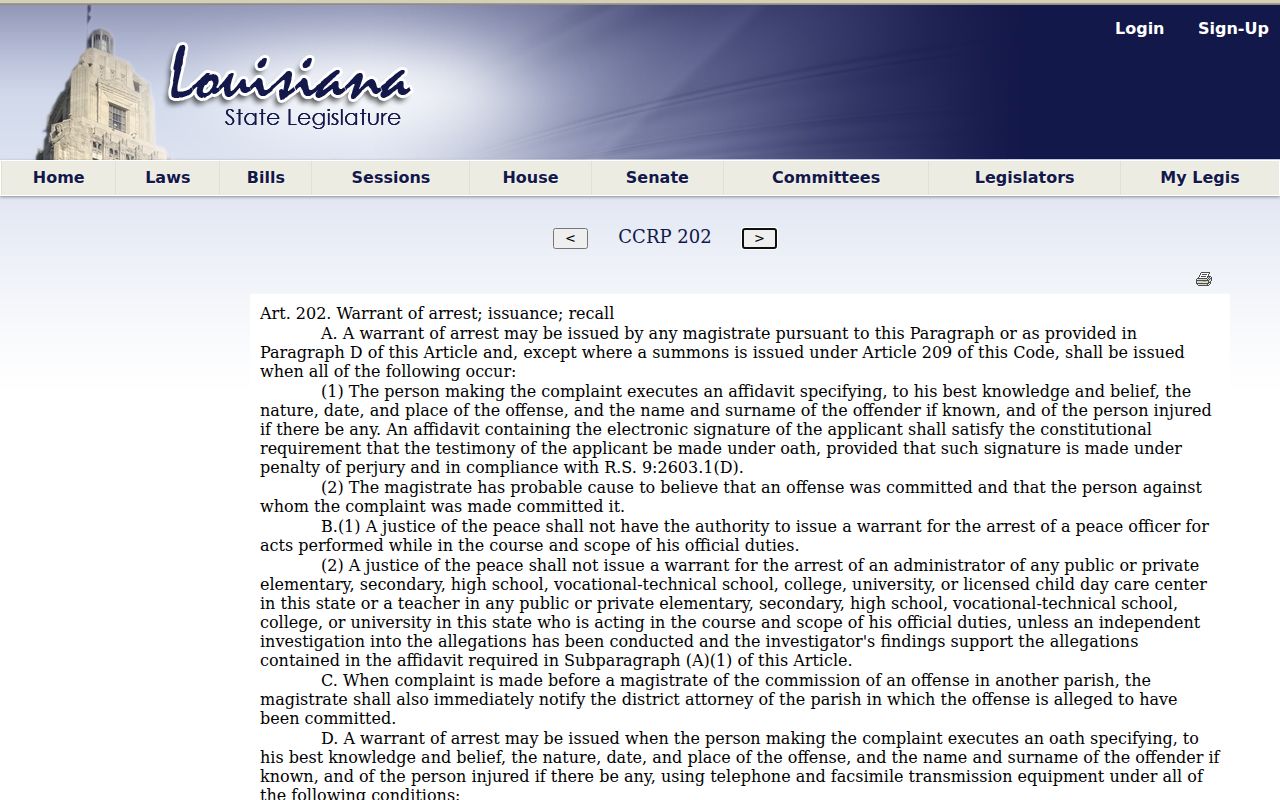
The statute frames the paperwork behind a Terrebonne Parish warrant, which is what a court will ask about when a case comes up by phone. Note: The affidavit and supporting material can be withheld while an investigation is open, so a public table may never show the full picture.
Inside a Terrebonne Parish Arrest Warrant
A warrant is a short document. It carries the facts that matter for service and release. In Terrebonne Parish, the public table summarizes part of it, and the court file holds the rest.
| Person named | The subject of the warrant, with descriptors used for identification |
|---|---|
| Offense | The charge or reason stated in the affidavit and the order |
| Issuing court | The magistrate or court that signed the process, such as a 32nd JDC division |
| Bond language | Cash, surety, no bond, or bond to be set by a magistrate |
| Warrant code | A/W in the public table, with the charge text beside it |
| Case or docket number | Not shown publicly; request it from the clerk or issuing court |
Who Serves Terrebonne Parish Warrants
The court that signs the process usually picks who serves it. That is why two warrants in Terrebonne Parish can end up with different agencies.
| Issuing Authority | Serving Agency | Notes |
|---|---|---|
| 32nd Judicial District Court | Sheriff's deputies, with specialized units for high-risk process | Booking and bond run through the Criminal Justice Complex |
| Houma City Court | Houma City Marshal | Houma police and the sheriff may assist |
| Justice of the peace court | The ward constable | Each ward has its own elected constable |
| Federal court | U.S. Marshals Service | Handled outside the parish system |
Serving Arrest Warrants in Terrebonne Parish
Service means the agency takes the named person into custody, notifies the jail, and starts booking. The sheriff's Criminal Division handles many Terrebonne Parish district court warrants, and its specialized teams take the high-risk ones. Houma police serve city matters inside the city. The City Marshal executes city court orders. An outstanding warrant can surface during a traffic stop or any other contact with an officer. Louisiana law lets an officer issue a summons instead of an arrest in some misdemeanor and traffic cases, but that choice belongs to the officer and the court, not to the person named.
Terrebonne Parish Warrant Bond Amounts
A bond figure in a public table is not a promise of release. The field can read 0.00 while the information text says no bond has been set. A surety figure differs from a cash figure, and a magistrate can add conditions that have nothing to do with money. Ask the Terrebonne Parish court two questions: which bond type it accepts on this warrant, and where that bond gets posted. The sheriff's payment page separates jail bonds from fines and citations. Paying a citation does not clear an arrest warrant.
Comparing Arrest, Summons, and Bench Warrants
Three court tools can bring a person before a judge in Terrebonne Parish. They are not interchangeable.
| Tool | How It Starts | What Happens Next |
|---|---|---|
| Arrest warrant | A sworn affidavit and a probable-cause finding | Custody, booking, and a bail or magistrate hearing |
| Summons | A court order to appear on a set date | An appearance, with a warrant possible if it is missed |
| Bench warrant | A missed date or a compliance failure in an open case | An appearance or other step needed to close the case |
Federal Warrants Outside Terrebonne Parish
Terrebonne Parish falls inside the Eastern District of Louisiana for federal matters. Federal warrants issue through federal judges or magistrates, and the U.S. Marshals Service handles fugitive cases. Federal dockets are not a public self-search warrant list. A warrant from another state can trigger a local arrest and a transfer request. Ask which jurisdiction issued it, whether Louisiana is holding the person for extradition, and which court controls the next hearing. An attorney is the right guide for an interstate detainer.
If There's an Arrest Warrant for You
An arrest warrant is the court's most serious appearance tool. It does not resolve itself. The practical paths in Terrebonne Parish are a lawyer-arranged appearance, a bond posting, and a motion asking the court to recall the warrant.
Important: Talk to a lawyer first. A voluntary appearance still ends in booking, and any contact with an officer can lead to arrest.
Call the issuing court before traveling anywhere. The public pages publish no warrant counter hours. The Terrebonne Parish sheriff's office asks people to call 985-876-2500 or the court before reporting in person.
Calling Terrebonne Parish Before a Surrender
A surrender takes planning. The questions below are the ones the Terrebonne Parish public pages do not answer on their own.
- Ask the issuing court whether the warrant is active and which division owns the case.
- Ask whether a lawyer can arrange a walk-through appearance and where it happens.
- Ask which bond type the court accepts and whether bond can be posted before custody.
- Ask whether the person goes to the courthouse or to the Criminal Justice Complex.
- Ask what identification and paperwork to bring, and get the answer from the court rather than a website.
If a warrant turns up, the steps to clear a Terrebonne Parish warrant start with an attorney and the issuing court. The county overview lays out the full sequence.